How the Fashion Industry Explots Models
Stolen pay. Sexual harassment. Months without a paycheck. Outrageous fees and expenses that eat away at earnings. And no one to plough to for help.
Models allege that labor abuses similar these run rampant in the modeling industry -- leaving many workers feeling more than like indentured servants than the glamorous high mode icons immature girls effectually the world dream of becoming.
While the industry oftentimes comes under fire for eating disorders, drug and booze abuse and unwanted sexual advances, its issues become far across that.
From an analysis of pay stubs and financial statements, interviews with dozens of current and former models, attorneys, labor experts and even a former bureau executive, a CNNMoney investigation has found that the way world often treats its models in means that would exist unheard of in many other industries. And due to a pregnant lack of regulation, these abuses can exist completely legal.
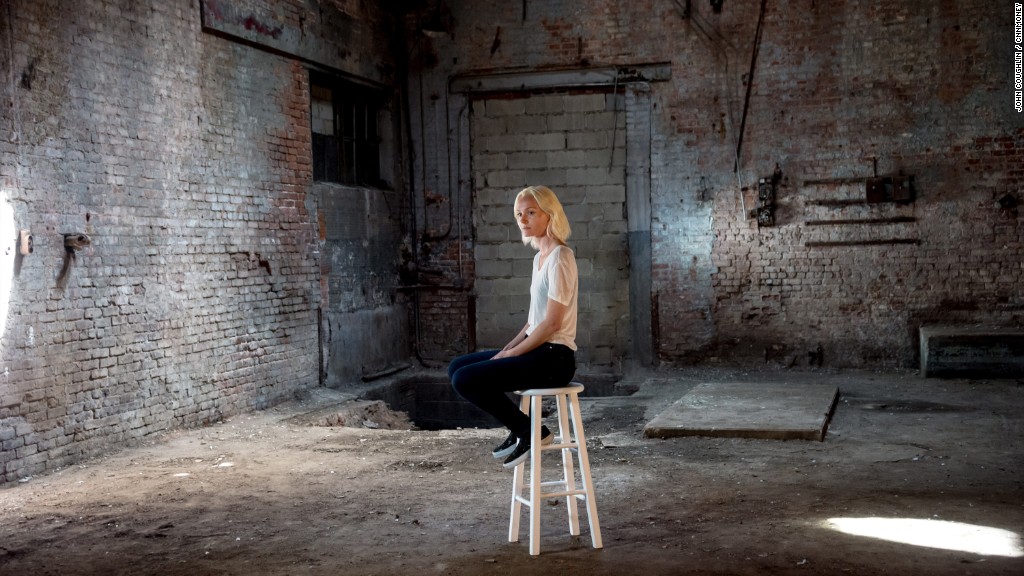
"It's not an easy industry, yous're not going to take a overnice lush lifestyle," said Emily Fob, who started out every bit a model at age sixteen and has appeared in Italian Faddy and walked on runways all over the world.
Now 25 years old and still working in the industry, Fox says that most years she earns less than $20,000 earlier taxes. "You're going to really struggle and you'll be actually poor."

Of course, equally in whatever creative and competitive industry, not everyone is going to go far. But models fence that industry practices are a large part of what keeps them from finding success -- particularly financially.
Ane model claims she was forced to rely on her begetter, a blueish collar worker in Ohio, to pay for groceries -- even later on gracing the pages of the Sports Illustrated Swimsuit Issue. Another, from Britain, resorted to working illegally as a bartender at an Irish pub in New York City to make ends meet. An 18-year-sometime who entered the business concluding summer and has already appeared on a number of European runways claims she has notwithstanding to receive a paycheck. And a Jamaican model ended up receiving just a few thousand dollars over 3 years of work in New York -- despite being promised a $75,000 annual salary on official visa documents. (Her bureau disputed any wrongdoing, calling the bacon a "guesstimate.")
Some situations are downright unsafe. In Florida, a number of young women were so desperate for modeling work that they savage victim to a fake business that allegedly drugged them and used them to create pornographic films.
Welcome to the dark side of the modeling manufacture -- the 1 that goes across the glossy magazine covers, designer labels and world famous rail shows.
"When you're a supermodel like Giselle or Christy Turlington you're treated like royalty, but 99% of models are treated similar garbage," said Carolyn Kramer, a quondam agency executive who compared the industry's labor abuses to those faced by immature factory workers at the turn of the century.
A cutthroat industry
For decades this world has operated in the shadows -- blatantly taking advantage of its young, mainly female workforce. Many models are thousands of miles away from their families, while strange models frequently speak trivial English language and are trapped in clearing programs that make them that much more vulnerable. Others aren't in immigration programs at all, just are instead encouraged by agencies to come to the U.s.a. illegally.
In many cases, models say it's the agency (or management company, as some call themselves) that takes advantage of them. While they say the designers and brands they pose for can also exist role of the problem, models interviewed by CNNMoney were more concerned near bureau practices and didn't unmarried out clients.
Of course, some agencies do indeed deed equally vehement protectors of their models. Just the lack of regulation (or a labor union similar actors, classical musicians and athletes have) makes information technology easy for bad apple agencies and fashion houses to thrive, allowing them to treat workers every bit zero more than a source of profits.
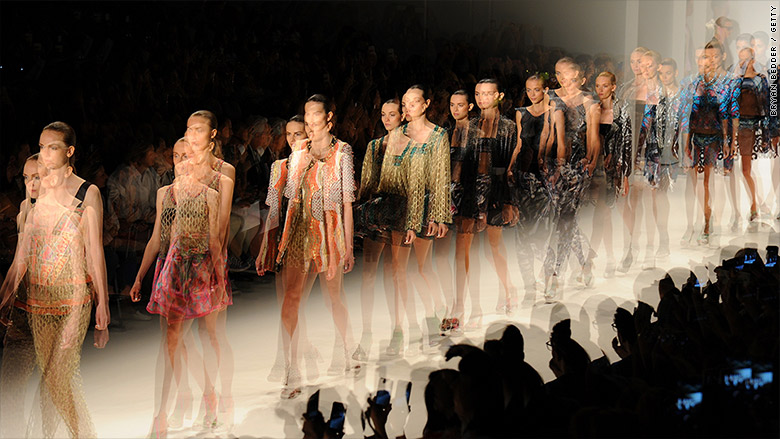
While the way globe's about famous faces rake in millions, many aspiring and working models earn unlivable pay and cease up indebted to their agencies -- as a perfect storm of 20% commissions and expenses drastically reduce earnings.
The few modeling companies that responded to CNNMoney's inquiries, however, were adamant that the financial issues models mutter about are unavoidable in a cutthroat and competitive industry -- that information technology'due south just the economic reality that most of the coin goes to a small fraction of models.
"Like in any industry, many models are not successful [due] to diverse issues, such every bit a lack of delivery, concrete issues, or personality flaws," said MC2, a modeling company, which said that it generally discontinues representing any New York-based model that makes less than $150,000 annually. "Just as non every actor or musician will find commercial success, non every model will be successful."
'A toxic power dynamic'
The manufacture's labor issues frequently stem from the fact that even though models say agencies command much of their lives (down to their eating habits and the pay they receive), they typically aren't considered employees.
Clients don't typically claim them every bit employees either. Instead, models are left as contract workers in an industry with fiddling oversight -- making it very difficult for them to challenge everything from wage theft to sexual harassment.
"There is this culture that comes from the agency that you are disposable and you are so lucky to be hither," said one-time model Meredith Hattam. "Information technology's a toxic power dynamic and information technology starts from the pinnacle."
A number of the industry'south top players are currently battling a lawsuit that challenges these very labor practices. The suit, proposed as a form activeness, alleges that the firms have unfairly profited off their models by charging exorbitant fees and expenses, incorrectly classifying them as independent contractors and withholding wages, amidst other allegations.
In response, the named modeling companies have denied any wrongdoing in court, claiming that allegations of stolen pay and unfair profits are baseless. They take also argued that information technology would be incorrect to consider models employees because they work sporadic hours and for all dissimilar clients.
Email u.s. tips and your ain stories at CNNMoney Investigates
MC2, for example, told CNNMoney the idea that a management company has consummate control of a model'south career is untrue, countering that "each model is free to decline any booking they choose."
An attorney for Click, another modeling company named in the lawsuit, wrote in courtroom filings that it'southward important to note that models technically hire a direction company -- and not the other way effectually. He also said it doesn't make sense to evoke minimum wage and overtime laws for models who can bill hundreds or even thousands of dollars a day.
And Katia Sherman, the president and co-founder of Major Model Management (which is as well named in the lawsuit), said that many companies like hers are mom-and-popular operations that wouldn't be able to survive if they were required to provide employee benefits to their models. She too said that just because her models aren't her employees doesn't mean she's non looking out for their best interests. And without these agencies to support aspiring models, it would be fifty-fifty harder for young people to break into the industry.
"My models are my children," said Sherman. "I care about all of them. This business is not all near money, but almost people."
Low pay, loftier expenses
Models interviewed past CNNMoney acknowledged that some agencies do negotiate fair compensation for shoots and chase downwardly deadbeat clients. Only many said that when they expected this kind of parental back up from their agents they were instead thrown to the wolves.
Many get their first in their early teens, and come to the big fashion meccas similar New York and Miami on their own. Desperate to please their agents and find work, they're willing to have pretty terrible labor conditions.
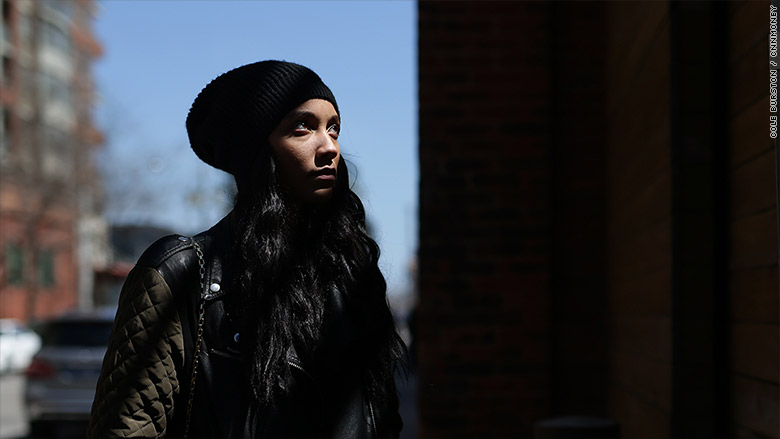
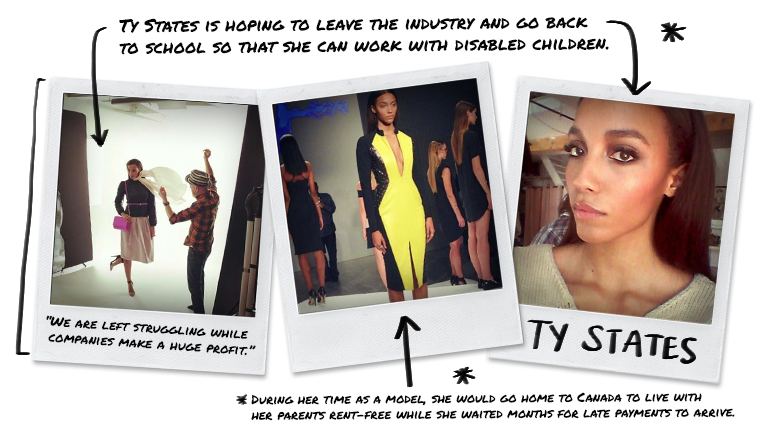
"We are left struggling while companies make a huge turn a profit," said Ty States, 24, who is hoping to leave the industry and go back to school so she can work with disabled children. During her time equally a model, she would become home to Canada to alive with her parents rent-free while she waited months for tardily payments to arrive.
Part of the trouble: the industry's more lucrative jobs -- like high-profile advertising campaigns -- are very competitive and typically become to those who have "paid their ante."
Meanwhile, loftier-profile gigs often pay very picayune, instead paying in prestige. CNNMoney saw countless examples of hours-long work -- from editorial shoots at fashion magazines to fancy runway shows -- that paid models $500 or less before commissions, taxes and expenses.
Others pay cipher more than free clothes, (though some say this practice is declining). That'south because agencies don't classify models every bit employees, and as a result they avoid minimum wage laws (though several lawsuits are currently challenging this classification). And the countless hours spent at castings, test shoots and go-sees (meetings with agents or designers) usually result in no compensation at all.
For the long hours she spent at runway shows and photo shoots, Fox has been paid with everything from a baroque dress that she has never worn to a pair of beige bellbottoms. Others say a coveted shoot for Vogue has earned them only effectually $200 (though the magazine has been known to help launch careers). Vogue declined on-the-tape comment for this story.
And no matter what the task is, agencies -- and clients -- can accept months to pay anything at all, models say. To beget their bills, some models resort to taking cash advances from their bureau, which further reduce their pay with fees of around five%.
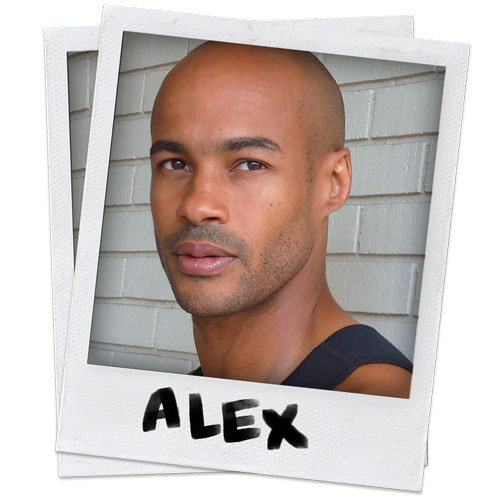
"A lot of us don't have rich parents or somebody to have care of us," said male model Alex Shanklin, who is part of the proposed form action arrange. "When you lot piece of work you lot would look to at least become a paycheck in a timely manner, but that never really seemed to exist the example. It was near a hide and go seek with the check."
When a paycheck does go far, information technology'southward often a fraction of what the client actually paid the agency. In addition to big commissions, earnings tin be devoured by other deductions equally models are billed for expenses ranging from walking lessons and dermatology visits to overpriced accommodations.
Marcelle Almonte says she was one of nine models who was charged as much as $i,850 a calendar month to stay in a 2-chamber "model flat" in Miami, co-ordinate to the same lawsuit. With a marketplace rate of around $3,000 a calendar month for the entire apartment (equally Almonte alleges in the adapt), this would mean the bureau could take taken in more than than $ten,000 a month in profits.
Want updates on this and other investigations? Sign upwards here
The management company, MC2, disputed this in a argument, challenge that it really lost money on the apartment considering of vacancies and models who didn't earn enough to cover their payments.
Meanwhile some other member of the lawsuit, Louisa Raske, who worked for clients like L'Oreal, says her agencies have billed her for everything from messenger service and website promotion to customer Christmas gifts and flowers given to her on her own altogether.
Expenses like these can leave workers in the red for months, years or even their unabridged careers.
Fox, for instance, says she's owed her agency at least $five,000 at a time, while Lisa Yanowitz (formerly Davies) says that she spent her fourteen-year modeling career bouncing in and out of debt. She has since left the manufacture to become a nurse, which she says is a much more stable job.
"Most models never manage to get out of debt. About models never brand any money," said prominent model and actress Milla Jovovich in a recent letter urging lawmakers to take action. In her letter, Jovovich detailed the "outrageous" expenses and labor abuses in the industry, even recalling how, as a teenager, she worked a 24-hour day with no pay.
Models acknowledge that the contracts they sign allow for these deductions, but they say that they are typically expected to pay with little proof or explanation of the charges.
And they worry that if they claiming these expenses, they volition be blacklisted from the future jobs they then desperately need.
"A lot of times if you get likewise concerned or you get besides involved, you can experience the agency not liking that," said Addison Gill, a Canadian model who has worked for clients including Calvin Klein, Louis Vuitton and Valentino. "They prefer to bargain with girls that aren't questioning them."
This is making it?
Even those who "make information technology"-- oftentimes earning around the half-dozen-effigy mark only far from the millions of dollars raked in by the industry's well-nigh famous -- yet merits they face a complete lack of transparency.
They complain that their agencies steal money that is rightfully theirs and continue to tack on excessive fees and expenses that can take up more than one-half of their pay. Almonte, for example, has a statement showing that lxx% of a $1,000 paycheck from a lingerie and swimwear visitor was eaten up past vague expenses charged past her agency (non even including commissions or taxes).
Others say that agencies and brands turn a profit off of their images without their knowledge -- and without paying them.
Retired model Carina Vretman, for example, says she has had to chase downwardly payments after seeing her face on everything from boxes of hair dye to London billboards. She says she would accept lost out on tens of thousands of dollars had she not fought back.
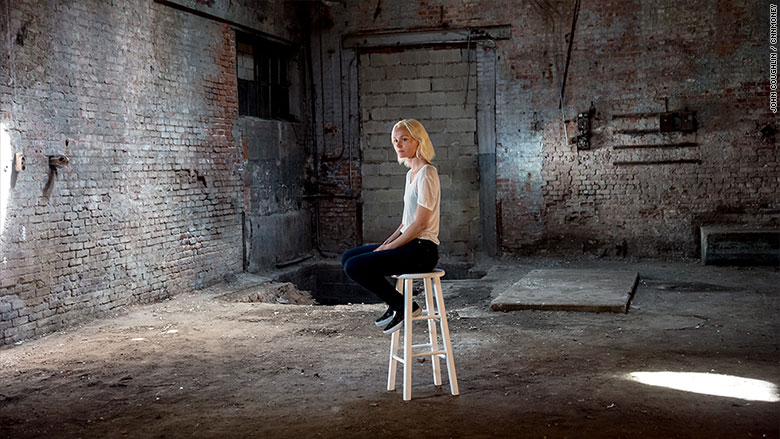
"Why should the agencies have my money?" said Vretman, who is also part of the proposed class-action lawsuit. "They are supposed to stand for me, they are supposed to be looking out for me. If they do this to me, can you imagine how many girls they have done this to?"
Lawyers for her agency, Wilhelmina, did not respond to requests for comment but take stated in court documents that the claims against the management company are "meritless."
Raske, a co-plaintiff in the same lawsuit, even alleges that someone at her agency forged her signature on a tax form in order to receive payments from a client without Raske's knowledge.
The company, Adjacent Model Management, did non reply to a asking for comment, though Next has denied any wrongdoing in court.
"It can exist an ugly manufacture -- the ugly industry of modeling," said Carlos Carvajal, a New York attorney, who is not involved in the electric current suit but has represented both models and their agencies.
Abuses remain unchecked
With little oversight of the manufacture, critics say calumniating agencies and their clients remain unchecked.
In contrast, consider another course of creative workers: actors. Whether they're on a commercial set or a Broadway stage, actors benefit from a laundry list of union protections, including mandatory breaks and overtime, minimum salary requirements and prompt payments. They also typically pay their agents commissions of only 10% because of union rules.
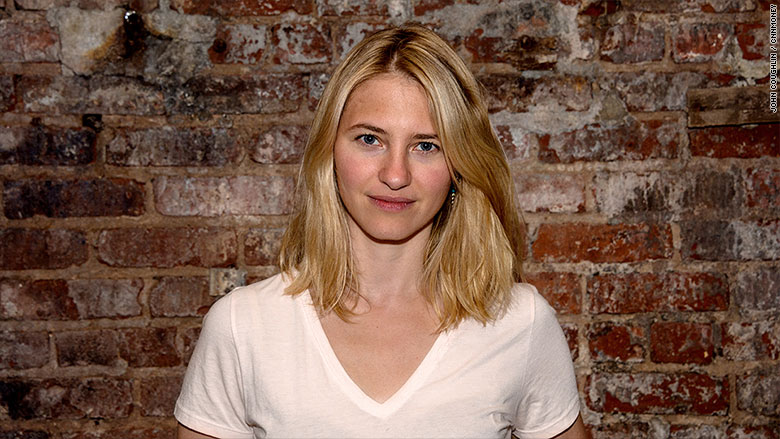
While actors have been unionized for decades, attempts by models have been crushed by agencies, said former model Sara Ziff, who was the confront of brands like Tommy Hilfiger and Stella McCartney before founding the Model Alliance, a labor advocacy group.
It's already very difficult for contained contractors to create a union since they lack many bones legal protections and rights, she said. Then there's the fright that they will be blacklisted if they join labor efforts.
As a effect, Ziff argues government regulation is sorely needed.
With no federal regulation of the industry, states accept taken a piecemeal approach. Merely some have laws requiring modeling agencies to be licensed. And while a contempo law in New York State, (where models often spend the bulk of their career) significantly strengthened protections for underage models, critics say at that place are still few protections for those 18 and older.
Meanwhile in California, a lawmaker has introduced legislation that advocates say would provide the strongest labor protections in the manufacture then far. The bill would crave models to be treated every bit employees, amidst a variety of other labor, health and safety-related regulations.
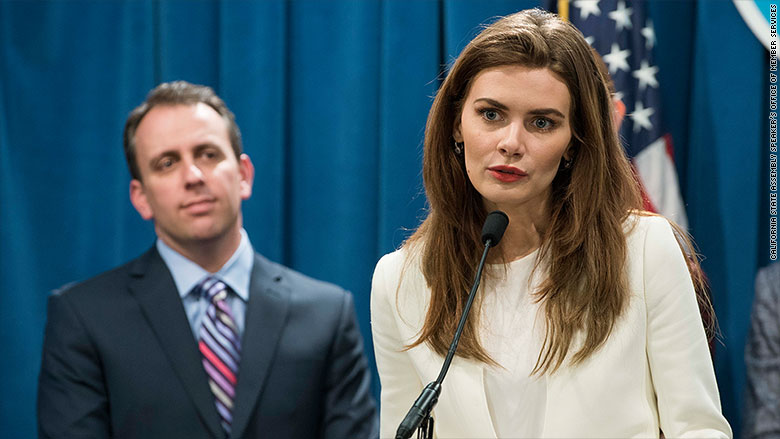
It is expected to be voted on past the legislature later this year, simply the industry is already fighting hard against it with a land merchandise grouping of talent agencies calling information technology "misguided and unnecessary."
And even if this landmark beak becomes law, information technology would only help workers in the land. So without a much larger overhaul of the way the manufacture operates, many say models will remain in the same vulnerable situations they've been in for decades.
"It'due south like throwing fish into a piranha tank," said longtime model Lorelei Shellist, who has appeared in magazines like Vogue and Marie Claire. "They're going to get devoured."
0 Response to "How the Fashion Industry Explots Models"
Post a Comment