Mens Fashion in America Mens Fashion in America Wikipedia

Fashion is a form of cocky-expression and autonomy at a detail period and place and in a specific context, of wearable, footwear, lifestyle, accessories, makeup, hairstyle, and body posture.[i] The term implies a expect defined past the fashion industry as that which is trending. Everything that is considered fashion is bachelor and popularized by the fashion organization (industry and media).
Due to increased mass-product of commodities and clothing at lower prices and global accomplish, sustainability has become an urgent issue among politicians, brands, and consumers.[two] [3]
Definitions [edit]
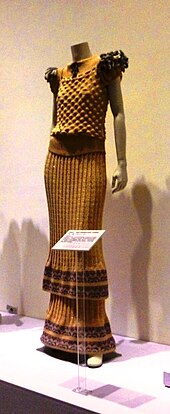
Reconstructed Roman women's way from Florence, Taipei 2013
Fashion scholar Susan B. Kaiser states that anybody is "forced to appear", unmediated before others.[4] Everyone is evaluated past their attire, and evaluation includes the consideration of colors, materials, silhouette, and how garments appear on the trunk. Garments identical in style and fabric also announced different depending on the wearer'southward body shape, or whether the garment has been washed, folded, mended, or is new.
Fashion is defined in a number of different ways, and its application can be sometimes unclear. Though the term fashion connotes difference, equally in "the new fashions of the season", it can also connote sameness, for example in reference to "the fashions of the 1960s", implying a general uniformity. Fashion can signify the latest trends, merely may often reference fashions of a previous era, leading to the understanding of fashions from a different time period re-appearing. While what is fashionable can be divers by a relatively insular, esteemed and often rich aesthetic elite who make a look exclusive, such as fashion houses and haute couturiers, this 'wait' is often designed by pulling references from subcultures and social groups who are not considered aristocracy, and are thus excluded from making the stardom of what is way themselves.
Whereas a trend often connotes a peculiar artful expression, often lasting shorter than a season and beingness identifiable past visual extremes, fashion is a distinctive and industry-supported expression traditionally tied to the way flavor and collections.[v] Style is an expression that lasts over many seasons and is oft continued to cultural movements and social markers, symbols, class, and culture (such as Baroque and Rococo). Co-ordinate to sociologist Pierre Bourdieu, manner connotes "the latest difference."[half dozen]
Even though the terms fashion, clothing and costume are often used together, way differs from both. Clothing describes the material and the technical garment, devoid of any social significant or connections; costume has come to mean fancy dress or masquerade article of clothing. Fashion, by contrast, describes the social and temporal organisation that influences and "activates" dress as a social signifier in a sure time and context. Philosopher Giorgio Agamben connects fashion to the qualitative Ancient Greek concept of kairos , meaning "the correct, critical, or opportune moment", and habiliment to the quantitative concept of chronos , the personification of chronological or sequential time.[7]
While some exclusive brands may claim the label haute couture, the term is technically limited to members of the Chambre Syndicale de la Haute Couture [8] in Paris.[v] Haute couture is more than aspirational; inspired past fine art and civilisation, and in almost cases, reserved for the economic elite.
Fashion is also a source of art, allowing people to display their unique tastes and styling.[nine] Different manner designers are influenced past outside stimuli and reflect this inspiration in their work. For instance, Gucci's 'stained green' jeans[10] may look like a grass stain, only to others, they display purity, freshness, and summertime.[i]
Style is unique, self-fulfilling and may be a key function of someone's identity. Similarly to art, the aims of a person's choices in fashion are non necessarily to exist liked past everyone, simply instead to be an expression of personal taste.[9] A person'due south personal fashion functions equally a "societal formation ever combining 2 reverse principles. It is a socially acceptable and secure style to distinguish oneself from others and, at the same time, it satisfies the private'southward demand for social adaptation and imitation."[xi] While philosopher Immanuel Kant believed that fashion "has nothing to do with 18-carat judgements of taste", and was instead "a example of unreflected and 'blind' simulated",[xi] sociologist Georg Simmel[12] idea of manner equally something that "helped overcome the distance between an individual and his lodge".[11]
Wear fashions [edit]

Reconstructed Roman women's fashions from Florence
Fashion is a form of expression. Fashion is what people wear in a specific context. If a stranger would announced in this setting, adorning something unlike, the stranger would be considered "out of fashion."
Early on Western[ when? ] travelers who visited Republic of india, Persia, Turkey, or Communist china, would frequently remark on the absenteeism of alter in way in those countries. In 1609, the secretary of the Japanese shōgun bragged inaccurately to a Castilian visitor that Japanese habiliment had not changed in over a grand years.[13] However, these conceptions of not-Western clothing undergoing little, if whatsoever, evolution are generally held to be untrue; for example, there is considerable bear witness in Ming China of quickly changing fashions in Chinese article of clothing.[xiv] Similar changes in clothing can be seen in Japanese clothing between the Genroku period and the subsequently centuries of the Edo period (1603-1867), during which a time wear trends switched from flashy and expensive displays of wealth to subdued and subverted ones.
Changes in wearable ofttimes took place at times of economic or social change, as occurred in ancient Rome and the medieval Caliphate, followed by a long menses without significant changes. In 8th-century Moorish Spain, the musician Ziryab introduced to Córdoba[15] [ unreliable source ] [16] sophisticated wear styles based on seasonal and daily fashions from his native Baghdad, modified past his inspiration. Similar changes in style occurred in the 11th century in the Centre East following the inflow of the Turks, who introduced wear styles from Central Asia and the Far East.[17]
Additionally, there is a long history of fashion in West Africa.[18] Cloth was used as a course of currency in trade with the Portuguese and Dutch every bit early as the 16th century,[18] and locally-produced textile and cheaper European imports were assembled into new styles to accommodate the growing elite class of West Africans and resident gold and slave traders.[18] There was an exceptionally strong tradition of weaving in the Oyo Empire, and the areas inhabited by the Igbo people.[eighteen]
Fashion in Europe and the Western hemisphere [edit]
The beginning in Europe of continual and increasingly-rapid change in wear styles can exist fairly reliably dated to late medieval times. Historians, including James Laver and Fernand Braudel, date the start of Western mode in wearable to the eye of the 14th century,[19] [20] though they tend to rely heavily on contemporary imagery,[21] as illuminated manuscripts were non mutual before the 14th century.[22] The nigh dramatic early change in fashion was a sudden desperate shortening and tightening of the male over-garment from dogie-length to barely covering the buttocks,[23] sometimes accompanied with stuffing in the chest to get in look bigger. This created the distinctive Western outline of a tailored summit worn over leggings or trousers.
The pace of alter accelerated considerably in the post-obit century, and women's and men's fashion, especially in the dressing and adorning of the pilus, became equally complex. Art historians are, therefore, able to apply manner with confidence and precision to engagement images, ofttimes to within v years, peculiarly in the instance of images from the 15th century. Initially, changes in manner led to a fragmentation beyond the upper classes of Europe of what had previously been a very like way of dressing and the subsequent evolution of distinctive national styles. These national styles remained very different until a counter-move in the 17th to 18th centuries imposed similar styles once again, mostly originating from Ancien Régime France.[24] Though the rich unremarkably led manner, the increasing abundance of early modernistic Europe led to the suburbia and even peasants following trends at a distance, just notwithstanding uncomfortably close for the elites – a factor that Fernand Braudel regards as one of the main motors of irresolute fashion.[25]
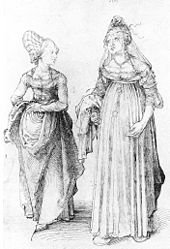
Albrecht Dürer's drawing contrasts a well-turned out bourgeoise from Nuremberg (left) with her counterpart from Venice. The Venetian lady'south high chopines make her await taller.
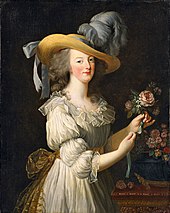
Marie Antoinette, wife of Louis XVI, was a leader of mode. Her choices, such as this 1783 white muslin apparel chosen a chemise a la Reine , were highly influential and widely worn.[26]
In the 16th century, national differences were at their near pronounced. 10 16th century portraits of German language or Italian gentlemen may show ten entirely different hats. Albrecht Dürer illustrated the differences in his actual (or blended) contrast of Nuremberg and Venetian fashions at the close of the 15th century (analogy, right). The "Castilian manner" of the late 16th century began the motion back to synchronicity amongst upper-class Europeans, and later a struggle in the mid-17th century, French styles decisively took over leadership, a process completed in the 18th century.[27]
Though different textile colors and patterns inverse from twelvemonth to year,[28] the cut of a admirer's coat and the length of his waistcoat, or the pattern to which a lady'due south dress was cut, changed more slowly. Men's fashions were primarily derived from war machine models, and changes in a European male silhouette were galvanized in theaters of European war where admirer officers had opportunities to make notes of different styles such as the "Steinkirk" cravat or necktie. Both parties wore shirts nether their article of clothing, the cutting and style of which had little cause to alter over a number of centuries.
Though in that location had been distribution of dressed dolls from French republic since the 16th century and Abraham Bosse had produced engravings of fashion in the 1620s, the pace of change picked upward in the 1780s with increased publication of French engravings illustrating the latest Paris styles. By 1800, all Western Europeans were dressing alike (or thought they were); local variation became first a sign of provincial civilisation and subsequently a badge of the bourgeois peasant.[29]
Although tailors and dressmakers were no doubt responsible for many innovations, and the cloth industry indeed led many trends, the history of mode pattern is generally understood to date from 1858 when the English language-built-in Charles Frederick Worth opened the get-go authentic haute couture firm in Paris. The Haute house was the proper noun established by the government for the fashion houses that met the standards of the industry. These way houses go on to adhere to standards such every bit keeping at least twenty employees engaged in making the clothes, showing 2 collections per twelvemonth at fashion shows, and presenting a sure number of patterns to costumers.[thirty] Since then, the thought of the fashion designer as a celebrity in their own right has become increasingly ascendant.[31]
Although fashion can be feminine or masculine, additional trends are androgynous.[32] The thought of unisex dressing originated in the 1960s, when designers such as Pierre Cardin and Rudi Gernreich created garments, such as stretch jersey tunics or leggings, meant to be worn by both males and females. The touch of unisex wearability expanded more broadly to encompass various themes in manner, including androgyny, mass-market retail, and conceptual clothing.[33] The mode trends of the 1970s, such as sheepskin jackets, flying jackets, duffel coats, and unstructured clothing, influenced men to attend social gatherings without a dinner jacket and to accessorize in new ways. Some men's styles blended the sensuality and expressiveness, and the growing gay-rights motion and an emphasis on youth immune for a new freedom to experiment with fashion and with fabrics such equally wool crepe, which had previously been associated with women's attire.[34]

The iv major current fashion capitals are best-selling to be Paris, Milan, New York City, and London, which are all headquarters to the well-nigh significant fashion companies and are renowned for their major influence on global way. Mode weeks are held in these cities, where designers exhibit their new clothing collections to audiences. A succession of major designers such every bit Coco Chanel and Yves Saint-Laurent have kept Paris equally the center almost watched by the remainder of the globe, although haute couture is now subsidized by the sale of ready-to-vesture collections and perfume using the same branding.
Modern Westeners accept a vast number of choices in the pick of their clothes. What a person chooses to wear can reflect their personality or interests. When people who accept loftier cultural status get-go to article of clothing new or dissimilar styles, they may inspire a new fashion tendency. People who like or respect these people are influenced by their style and begin wearing similarly styled dress.
Fashions may vary considerably within a society according to age, social class, generation, occupation, and geography, and may too vary over time. The terms fashionista and fashion victim refer to someone who slavishly follows current fashions.
In the early 2000s, Asian fashion became increasingly significant in local and global markets. Countries such every bit China, Japan, India, and Pakistan have traditionally had large textile industries with a number of rich traditions; though these were oftentimes drawn upon past Western designers, Asian clothing styles gained considerable influence in the early- to mid-2000s.[35]
Fashion industry [edit]
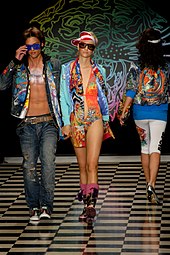
In its virtually common use, the term fashion refers to the current expressions on sale through the fashion manufacture. The global fashion industry is a product of the modern age.[36] In the Western globe, tailoring has since medieval times been controlled by guilds, but with the emergence of industrialism, the ability of the guilds was undermined. Before the mid-19th century, most article of clothing was custom-made. It was handmade for individuals, either as home production or on guild from dressmakers and tailors. By the beginning of the 20th century, with the rise of new technologies such equally the sewing car, the rise of global trade, the development of the factory system of production, and the proliferation of retail outlets such every bit department stores, clothing became increasingly mass-produced in standard sizes and sold at stock-still prices.
Although the fashion industry developed kickoff in Europe and America, every bit of 2017[update], information technology is an international and highly globalized manufacture, with clothing ofttimes designed in one state, manufactured in another, and sold worldwide. For example, an American fashion company might source material in China and have the clothes manufactured in Vietnam, finished in Italian republic, and shipped to a warehouse in the United States for distribution to retail outlets internationally.
The fashion industry was for a long fourth dimension i of the largest employers in the United states of america,[36] and it remains then in the 21st century. Nevertheless, U.S. employment in fashion began to pass up considerably as production increasingly moved overseas, particularly to Prc. Because data on the fashion manufacture typically are reported for national economies and expressed in terms of the industry's many separate sectors, aggregate figures for the world production of textiles and clothing are difficult to obtain. Nevertheless, by any measure, the wear industry accounts for a meaning share of world economic output.[37] The fashion industry consists of four levels:
- The production of raw materials, principally Fiber, and textiles but likewise leather and fur.
- The production of style appurtenances past designers, manufacturers, contractors, and others.
- Retail sales.
- Diverse forms of advertising and promotion.
The levels of focus in the fashion industry consist of many separate but interdependent sectors. These sectors include Material Design and Production, Style Design and Manufacturing, Mode Retailing, Marketing and Merchandising, Manner Shows, and Media and Marketing. Each sector is devoted to the goal of satisfying consumer need for dress under weather condition that enable participants in the industry to operate at a profit.[36]
Way trend [edit]
A mode trend signifies a specific look or expression that is spread across a population at a specific time and place. A trend is considered a more than ephemeral await, not defined by the seasons when collections are released by the mode manufacture. A tendency can thus emerge from street style, across cultures, from influencers and celebrities.
Fashion trends are influenced by several factors, including movie theatre, celebrities, climate, creative explorations, innovations, designs, political, economic, social, and technological. Examining these factors is called a PEST analysis. Fashion forecasters can use this information to assist determine the growth or refuse of a item tendency.
[edit]


Fashion is inherently a social miracle. A person cannot accept a style by oneself, but for something to be divers as fashion, there needs to be dissemination and followers. This dissemination can accept several forms; from the top-downwardly ("trickle-down") to bottom-upwardly ("chimera up"), or transversally beyond cultures and through viral memes and media.
Fashion relates to the social and cultural context of an environment. Co-ordinate to Matika,[38] "Elements of popular culture become fused when a person'due south trend is associated with a preference for a genre of music…like music, news or literature, manner has been fused into everyday lives." Mode is not only seen as purely artful; fashion is also a medium for people to create an overall consequence and express their opinions and overall art.
This mirrors what performers frequently achieve through music videos. In the music video 'Formation' by Beyoncé, according to Carlos,[39] "The pop star pays homage to her Creole roots.... tracing the roots of the Louisiana cultural nervus center from the post-abolition era to present day, Beyoncé catalogs the evolution of the city'south vibrant mode and its tumultuous history all at once. Atop a New Orleans law auto in a red-and-white Gucci high-collar dress and gainsay boots, she sits amidst the ruins of Hurricane Katrina, immediately implanting herself in the biggest national debate on police brutality and race relations in modern day."
The annual or seasonal runway show is a reflection of manner trends and a designer's inspirations. For designers like Vivienne Westwood, runway shows are a platform for her voice on politics and current events. For her AW15 menswear show, according to Water,[forty] "where models with severely bruised faces channeled eco-warriors on a mission to salvage the planet." Another contempo example is a staged feminist protest march for Chanel's SS15 show, rioting models chanting words of empowerment with signs similar "Feminist but feminine" and "Ladies outset." Co-ordinate to Water,[40] "The show tapped into Chanel's long history of championing female independence: founder Coco Chanel was a trailblazer for liberating the female person torso in the postal service-WWI era, introducing silhouettes that countered the restrictive corsets and then in favour."
The almanac Academy Awards ceremony is also a venue where fashion designers and their creations are celebrated.
Social media is as well a place where mode is presented well-nigh often. Some influencers are paid huge amounts of coin to promote a product or clothing item, where the concern hopes many viewers will purchase the product off the back of the advert. Instagram is the near popular platform for advertising, but Facebook, Snapchat, Twitter and other platforms are also used.[41]
Economic influences [edit]
Circular economy [edit]
With increasing environmental awareness, the economic imperative to "Spend now, think later" is getting increasingly scrutinized.[42] Today's consumer tends to be more mindful most consumption, looking for just plenty and better, more durable options. People take also become more witting of the impact their everyday consumption has on the environs and society, and these initiatives are often described every bit a motility towards sustainable fashion, yet critics contend a circular economy based on growth is an oxymoron, or an increasing screw of consumption, rather than a utopian cradle-to-cradle round solution.
In today's linear economic system, manufacturers extract resource from the earth to make products that will before long be discarded in landfills, on the other hand, under the round model, the product of goods operates like systems in nature, where the waste and demise of a substance becomes the nutrient and source of growth for something new. Companies such as MUD Jeans, which is based in the Netherlands employ a leasing scheme for jeans. This Dutch company "represents a new consuming philosophy that is about using instead of owning," according to MUD'southward website. The concept also protects the visitor from volatile cotton prices. Consumers pay €seven.l a calendar month for a pair of jeans; later a year, they tin can render the jeans to Mud, trade them for a new pair and start some other twelvemonth-long lease, or go on them. MUD is responsible for any repairs during the charter period.[42] Some other ethical mode company, Patagonia gear up up the commencement multi-seller branded shop on eBay to facilitate secondhand sales; consumers who take the Common Threads pledge can sell in this store and accept their gear listed on Patagonia.com's "Used Gear" section.[42]
People's republic of china's domestic spending [edit]
Consumption as a share of gross domestic production in Cathay has fallen for six decades, from 76 per centum in 1952 to 28 pct in 2011. Communist china plans to reduce tariffs on a number of consumer goods and expand its 72-hr transit visa plan to more than cities in an effort to stimulate domestic consumption.[43]
The announcement of import tax reductions follows changes in June 2015, when the authorities cut the tariffs on habiliment, cosmetics and diverse other appurtenances by half. Amid the changes – easier tax refunds for overseas shoppers and accelerated openings of more duty-complimentary shops in cities covered by the 72-60 minutes visa scheme. The 72-hour visa was introduced in Beijing and Shanghai in January 2013 and has been extended to 18 Chinese cities.[43]
According to reports at the same time, Chinese consumer spending in other countries such as Japan has slowed even though the yen has dropped.[44] At that place is conspicuously a trend in the adjacent 5 years that the domestic fashion market place will show an increase.
China is an interesting marketplace for fashion retail as Chinese consumers' motivation to shop for way items are unique from Western Audiences.[45] Demographics have limited association with shopping motivation, with occupation, income and education level having no impact; unlike in Western Countries. Chinese high-street shoppers prefer adventure and social shopping, while online shoppers are motivated by idea shopping. Some other difference is how gratification and idea shopping influence spending over ¥1k per month on fashion items, and regular spending influenced by value shopping.
Marketing [edit]
Market research [edit]
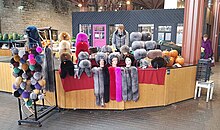
Consumers of unlike groups have varying needs and demands. Factors taken into consideration when thinking of consumers' needs include key demographics.[46] To understand consumers' needs and predict manner trends, way companies have to practice market inquiry[47] In that location are two research methods: chief and secondary.[48] Secondary methods are taking other information that has already been collected, for example using a book or an commodity for enquiry. Master research is collecting information through surveys, interviews, observation, and/or focus groups. Primary research ofttimes focuses on big sample sizes to determine client'south motivations to shop.[45]
The benefits of primary enquiry are specific information well-nigh a fashion make'south consumer is explored. Surveys are helpful tools; questions can be open up-ended or closed-ended. Negative factor surveys and interviews present is that the answers can be biased, due to diction in the survey or on face-to-confront interactions. Focus groups, about 8 to 12 people, can be beneficial because several points tin can exist addressed in depth. However, there are drawbacks to this tactic, besides. With such a small sample size, it is difficult to know if the greater public would react the aforementioned style equally the focus group.[48] Observation tin really help a visitor gain insight on what a consumer truly wants. There is less of a bias because consumers are just performing their daily tasks, not necessarily realizing they are beingness observed. For case, observing the public past taking street style photos of people, the consumer did non get dressed in the morn knowing that would have their photo taken necessarily. They just wear what they would normally habiliment. Through observation patterns can exist seen, helping trend forecasters know what their target market place needs and wants.
Knowing the needs of consumers will increase fashion companies' sales and profits. Through research and studying the consumers' lives the needs of the customer can be obtained and help fashion brands know what trends the consumers are ready for.
Symbolic consumption [edit]
Consumption is driven non only by demand, the symbolic meaning for consumers is also a factor. Consumers engaging in symbolic consumption may develop a sense of self over an extended period of time every bit various objects are collected as part of the process of establishing their identity and, when the symbolic meaning is shared in a social group, to communicate their identity to others. For teenagers, consumption plays a function in distinguishing the child self from the adult. Researchers have plant that the fashion choices of teenagers are used for cocky-expression and also to recognize other teens who wear similar clothes. The symbolic association of clothing items tin link individuals' personality and interests, with music as a prominent factor influencing style decisions.[49]
Political influences [edit]

Political figures accept played a key role in the development of fashion, at least since the fourth dimension of French rex Louis 14. For example, First Lady Jacqueline Kennedy was a way icon of the early on 1960s. Wearing Chanel suits, structural Givenchy shift dresses, and soft colour Cassini coats with large buttons, she inspired trends of both elegant formal dressing and classic feminine way.[50]
Cultural upheavals have also had an bear upon on fashion trends. For example, during the 1960s, the U.S. economy was robust, the divorce charge per unit was increasing, and the government approved the birth control pill. These factors inspired the younger generation to rebel confronting entrenched social norms. The civil rights movement, a struggle for social justice and equal opportunity for Blacks, and the women's liberation movement, seeking equal rights and opportunities and greater personal liberty for women, were in full bloom. In 1964, the leg-baring mini-skirt was introduced and became a white-hot trend. Way designers then began to experiment with the shapes of garments: loose sleeveless dresses, micro-minis, flared skirts, and trumpet sleeves. Fluorescent colors, impress patterns, bell-bottom jeans, fringed vests, and skirts became de rigueur outfits of the 1960s.[51]
Concern and protestation over U.S involvement in the failing Vietnam War also influenced fashion . Camouflage patterns in war machine clothing, adult to aid armed services personnel be less visible to enemy forces, seeped into streetwear designs in the 1960s. Camouflage trends have disappeared and resurfaced several times since then, appearing in high fashion iterations in the 1990s.[52] Designers such as Valentino, Dior, and Dolce & Gabbana combined camouflage into their runway and ready-to-wearable collections. Today, variations of camouflage, including pastel shades, in every clothing or accessory, keep to enjoy popularity.
Technology influences [edit]
Today, technology plays a sizable role in lodge, and technological influences are correspondingly increasing within the realm of fashion. Wearable applied science has go incorporated; for example, habiliment synthetic with solar panels that charge devices and smart fabrics that raise wearer comfort by irresolute color or texture based on environmental changes.[53] 3D printing applied science has influenced designers such every bit Iris van Herpen and Kimberly Ovitz. As the engineering evolves, 3D printers volition become more accessible to designers and somewhen, consumers — these could potentially reshape design and production in the manner industry entirely.
Internet engineering science, enabling the far reaches of online retailers and social media platforms, has created previously unimaginable ways for trends to be identified, marketed, and sold immediately.[54] Tendency-setting styles are hands displayed and communicated online to concenter customers. Posts on Instagram or Facebook can rapidly increase awareness about new trends in style, which subsequently may create loftier demand for specific items or brands,[55] new "buy at present push button" engineering science tin link these styles with direct sales.
Machine vision engineering has been developed to track how fashions spread through gild. The manufacture can at present run across the direct correlation on how fashion shows influence street-chic outfits. Effects such as these can now be quantified and provide valuable feedback to fashion houses, designers, and consumers regarding trends.[56]
Media [edit]

The media plays a significant role when it comes to mode. For instance, an important part of fashion is way journalism. Editorial critique, guidelines, and commentary can be found on television and in magazines, newspapers, fashion websites, social networks, and mode blogs. In recent years, fashion blogging and YouTube videos take go a major outlet for spreading trends and fashion tips, creating an online culture of sharing one'due south style on a website or social media accounts (like instagram, tiktok, or twitter). Through these media outlets, readers and viewers all over the world tin can learn about fashion, making information technology very accessible.[57] In addition to fashion journalism, another media platform that is of import in fashion industry is advertizing. Advertisements provide information to audiences and promote the sales of products and services. The way manufacture utilizes advertisements to attract consumers and promote its products to generate sales. A few decades ago when engineering science was still underdeveloped, advertisements heavily relied on radio, magazines, billboards, and newspapers.[58] These days, there are more various ways in advertisements such every bit television ads, online-based ads using net websites, and posts, videos, and alive streaming in social media platforms.
Fashion in printed media [edit]
There are two subsets of print styling: editorial and lifestyle. Editorial styling is the high - fashion styling seen in manner magazines, and this tends to be more artistic and mode-forward. Lifestyle styling focuses on a more overtly commercial goal, like a department store advertisement, a website, or an advertisement where way is not what's being sold but the models hired to promote the product in the photo.[59]
The dressing practices of the powerful accept traditionally been mediated through fine art and the practices of the courts. The looks of the French courtroom were disseminated through prints from the 16th century on, just gained cohesive blueprint with the development of a centralized court under Rex Louis XIV, which produced an identifiable way that took his name.[sixty] At the commencement of the 20th century, fashion magazines began to include photographs of various fashion designs and became fifty-fifty more than influential than in the past.[61] In cities throughout the world these magazines were greatly sought afterward and had a profound outcome on public gustation in clothing. Talented illustrators drew exquisite style plates for the publications which covered the nigh recent developments in fashion and dazzler. Perchance the about famous of these magazines was La Gazette du Bon Ton, which was founded in 1912 by Lucien Vogel and regularly published until 1925 (with the exception of the war years).[62]
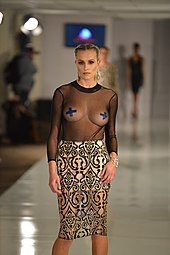
Vogue, founded in the United States in 1892, has been the longest-lasting and most successful of the hundreds of fashion magazines that take come and gone. Increasing abundance after World War II and, about importantly, the advent of cheap colour press in the 1960s, led to a huge boost in its sales and heavy coverage of fashion in mainstream women'due south magazines, followed by men's magazines in the 1990s. I such example of Vogue's popularity is the younger version, Teen Faddy, which covers clothing and trends that are targeted more than toward the "fashionista on a upkeep". Haute couture designers followed the trend by starting ready-to-wear and perfume lines which are heavily advertised in the magazines and now dwarf their original couture businesses. A recent development within fashion print media is the rising of text-based and critical magazines which aim to prove that mode is not superficial, past creating a dialogue between mode academia and the manufacture. Examples of this development are: Fashion Theory (1997), Fashion Practice: The Journal of Design, Creative Procedure & the Way Industry (2008), and Vestoj (2009).
Style in telly [edit]
Television coverage began in the 1950s with modest fashion features. In the 1960s and 1970s, fashion segments on various amusement shows became more frequent, and by the 1980s, dedicated fashion shows such equally Manner Television started to announced. FashionTV was the pioneer in this undertaking and has since grown to become the leader in both Fashion Television set and new media channels. The Fashion Industry is beginning to promote their styles through Bloggers on social media's. Faddy specified Chiara Ferragni every bit "blogger of the moment" due to the rises of followers through her Fashion Web log, that became popular.[63]
A few days after the 2010 Fall Style Week in New York Urban center came to a close, The New Islander's Fashion Editor, Genevieve Taxation, criticized the fashion industry for running on a seasonal schedule of its own, largely at the expense of real-world consumers. "Because designers release their autumn collections in the spring and their bound collections in the fall, fashion magazines such equally Vogue ever and just await forward to the upcoming season, promoting parkas come up September while issuing reviews on shorts in January", she writes. "Savvy shoppers, consequently, have been conditioned to be extremely, perhaps impractically, farsighted with their buying."[64]
The style industry has been the subject area of numerous films and television shows, including the reality show Projection Runway and the drama series Ugly Betty. Specific fashion brands have been featured in film, not simply as product placement opportunities, but as bespoke items that take after led to trends in manner.[65]
Videos in general take been very useful in promoting the mode industry. This is axiomatic not only from goggle box shows straight spotlighting the style manufacture, only also movies, events and music videos which showcase way statements besides every bit promote specific brands through product placements.
Controversial advertisements in fashion industry [edit]
Racism in fashion advertisements [edit]
Some fashion advertisements have been accused of racism and led to boycotts from customers. Globally known Swedish fashion make H&M faced this outcome with one of its children'south wear advertisements in 2018. A Black child wearing a hoodie with the slogan "coolest monkey in the jungle" was featured in the advertisement. This immediately led to controversy, as "monkey" is commonly used as slur against Blackness people, and caused many customers to boycott the make. Many people, including celebrities, posted on social media about their resentments towards H&G and refusal to piece of work with and buy its products. H&M issued a statement saying "we apologise to anyone this may have offended", though this too received some criticism for appearing insincere.[66]
Another fashion advertisement seen as racist was from GAP, an American worldwide clothing brand. GAP collaborated with Ellen DeGeneres in 2016 for the advertisement. Information technology features 4 playful young girls, with a tall White girl leaning with her arm on a shorter Black daughter's head. Upon release, some viewers harshly criticized it, claiming information technology shows an underlying passive racism. A representative from The Root commented that the ad portrays the message that Black people are undervalued and seen as props for White people to look better.[67] Others saw niggling consequence with the ad, and that the controversy was the issue of people being oversensitive. GAP replaced the image in the ad and apologized to critics.[68]
Sexism in fashion advertisements [edit]
Many style brands have published ads that were provocative and sexy to concenter customers' attention. British high fashion make, Jimmy Choo, was blamed for having sexism in its ad which featured a female British model wearing the brand'southward boots. In this two-minute advertizement, men whistle at a model, walking on the street with red, sleeveless mini dress. This advertizement gained much backlash and criticism by the viewers, equally it was seen as promoting sexual harassment and other misconduct. Many people showed their dismay through social media posts, leading Jimmy Choo to pull down the advertizement from social media platforms.[69]
French luxury mode brand Yves Saint Laurent likewise faced this issue with its impress advertizement shown in Paris in 2017. The advertising depicted a female model wearing fishnet tights with roller-skate stilettos reclining with her legs opened in front of the camera. This ad brought harsh comments from both viewers and French advertisement organization directors for going against the advertising codes related to "respect for decency, nobility and those prohibiting submission, violence or dependence, besides every bit the use of stereotypes." and additionally said that this ad was causing "mental damage to adolescents."[70] Due to the negative public reaction, the poster was removed from the city.
Public relations and social media [edit]

Fashion public relations involves being in affect with a company's audiences and creating strong relationships with them, reaching out to media, and initiating messages that project positive images of the company.[71] Social media plays an important part in modern-twenty-four hours manner public relations; enabling practitioners to reach a wide range of consumers through various platforms.[72]
Building brand awareness and credibility is a key implication of good public relations. In some cases, the hype is built nearly new designers' collections before they are released into the market, due to the immense exposure generated by practitioners.[73] Social media, such as blogs, microblogs, podcasts, photograph and video sharing sites have all become increasingly of import to manner public relations.[74] The interactive nature of these platforms allows practitioners to engage and communicate with the public in real-time, and tailor their clients' brand or campaign messages to the target audience. With blogging platforms such as Instagram, Tumblr, WordPress, Squarespace, and other sharing sites, bloggers accept emerged as expert fashion commentators, shaping brands and having a great impact on what is 'on trend'.[75] Women in the manner public relations manufacture such every bit Sweaty Betty PR founder Roxy Jacenko and Oscar de la Renta'due south PR girl Erika Bearman, accept acquired copious followers on their social media sites, by providing a brand identity and a behind the scenes look into the companies they work for.
Social media is changing the way practitioners evangelize messages,[23] as they are concerned with the media, and as well client human relationship edifice.[76] PR practitioners must provide constructive communication among all platforms, in order to appoint the way public in an manufacture socially continued via online shopping.[77] Consumers accept the ability to share their purchases on their personal social media pages (such every bit Facebook, Twitter, Instagram, etc.), and if practitioners deliver the brand bulletin finer and meet the needs of its public, discussion-of-oral cavity publicity will be generated and potentially provide a wide reach for the designer and their products.
Fashion and political activism [edit]
As manner concerns people, and signifies social hierarchies, manner intersects with politics and the social system of societies. Whereas haute couture and business concern suits are associated past people in ability, also groups aiming to challenge the political social club also use apparel to signal their position. The explicit use of fashion as a form of activism, is usually referred to as "style activism."
There is a complex relationship between fashion and feminism. Some feminists accept argued that by participating in feminine fashions women are contributing to maintaining the gender differences which are role of women's oppression.[78] Brownmiller felt that women should decline traditionally feminine clothes, focusing on condolement and practicality rather than mode.[78] Others believe that information technology is the way organization itself that is repressive in requiring women to seasonally change their clothes to keep up with trends.[79] Greer has advocated this argument that seasonal changes in apparel should be ignored; she argues that women can be liberated by replacing the compulsiveness of way with enjoyment of rejecting the norm to create their own personal styling.[fourscore] This rejection of seasonal manner led to many protests in the 1960s alongside rejection of mode on socialist, racial and environmental grounds.[81] However, Mosmann has pointed out that the human relationship between protesting style and creating fashion is dynamic considering the language and style used in these protests has then become part of fashion itself.[81]
Manner designers and brands have traditionally kept themselves out of political conflicts, there has been a movement in the industry towards taking more explicit positions beyond the political spectrum. From maintaining a rather apolitical stance, designers and brands today engage more explicitly in current debates.[82]
For example, considering the U.South.'south political climate in the surrounding months of the 2016 presidential ballot, during 2017 fashion weeks in London, Milan, New York, Paris and São Paulo amongst others, many designers took the opportunity to take political stances leveraging their platforms and influence to reach their customers.[83] [84] This has also led to some controversy over autonomous values, as fashion is not e'er the most inclusive platform for political debate, only a one-way circulate of top-downwards messages.
When taking an explicit political stance, designers mostly favor issues that can exist identified in clear language with virtuous undertones. For example, aiming to "amplify a greater message of unity, inclusion, diversity, and feminism in a mode infinite", designer Mara Hoffman invited the founders of the Women'due south March on Washington to open up her show which featured modern silhouettes of utilitarian wearable, described by critics as "Made for a modern warrior" and "Wearable for those who still take work to do".[85] Prabal Gurung debuted his collection of T-shirts featuring slogans such every bit "The Time to come is Female", "We Will Not Exist Silenced", and "Nevertheless She Persisted", with proceeds going to the ACLU, Planned Parenthood, and Gurung's own charity, "Shikshya Foundation Nepal".[82] Similarly, The Business concern of Manner launched the #TiedTogether movement on Social Media, encouraging member of the industry from editors to models, to article of clothing a white bandana advocating for "unity, solidarity, and inclusiveness during fashion week".[86]
Fashion may be used to promote a cause, such as to promote salubrious behavior,[87] to raise money for a cancer cure,[88] or to raise money for local charities[89] such every bit the Juvenile Protective Association[90] or a children'south hospice.[91]
One fashion cause is trashion, which is using trash to make apparel, jewelry, and other fashion items in order to promote awareness of pollution. In that location are a number of modern trashion artists such every bit Marina DeBris, Ann Wizer,[92] and Nancy Judd.[93] Other designers accept used DIY fashions, in the tradition of the punk movement, to accost elitism in the industry to promote more inclusion and diversity.[94]
Anthropological perspective [edit]
From an academic lens, the sporting of various fashions has been seen as a form of fashion language, a mode of advice that produced various manner statements, using a grammar of way.[95] This is a perspective promoted in the work of influential French philosopher and semiotician Roland Barthes.
Anthropology, the study of culture and of human societies, examines fashion by asking why certain styles are deemed socially appropriate and others are not. From the theory of interactionism, a certain practice or expression is chosen past those in power in a customs, and that becomes "the mode" as divers at a certain time by the people under influence of those in power. If a particular style has a meaning in an already occurring gear up of beliefs, then that fashion may accept a greater chance of become fashion.[96]
According to cultural theorists Ted Polhemus and Lynn Procter, one can describe mode as beautification, of which there are 2 types: style and anti-fashion. Through the capitalization and commoditization of clothing, accessories, and shoes, etc., what once constituted anti-fashion becomes part of fashion as the lines between way and anti-fashion are blurred, as expressions that were once outside the changes of style are swept along with trends to signify new meanings.[97] Examples range from how elements from ethnic dress becomes part of a tendency and appear on catwalks or street cultures, for example how tattoos travel from sailors, laborers and criminals to popular culture.
To cultural theorist Malcolm Bernard, fashion and anti-style differ as polar opposites. Anti-fashion is stock-still and changes little over time,[98] varying depending on the cultural or social group i is associated with or where i lives, but within that group or locality the style changes footling. Way, in contrast, can change (evolve) very rapidly[99] and is not affiliated with one group or area of the world but spreads throughout the world wherever people tin can communicate hands with each other. An example of anti-fashion would exist formalism or otherwise traditional clothing where specific garments and their designs are both reproduced faithfully and with the intent of maintaining a status quo of tradition. This tin can be seen in the article of clothing of some kabuki plays, where some character outfits are kept intact from designs of several centuries ago, in some cases retaining the crests of the actors considered to take 'perfected' that role.
Anti-fashion is concerned with maintaining the condition quo, while fashion is concerned with social mobility. Time is expressed in terms of continuity in anti-fashion, and in terms of change in style; fashion has changing modes of beautification, while anti-way has fixed modes of beautification.
From this theoretical lens, alter in fashion is part of the larger industrial system and is structured past the powerful actors in this system to be a deliberate change in manner, promoted through the channels influenced by the industry (such equally paid advertisements).[100]
Intellectual belongings [edit]
In the fashion industry, intellectual property is not enforced equally it is within the picture manufacture and music manufacture. Robert Glariston, an intellectual property practiced, mentioned in a manner seminar held in LA[ which? ] that "Copyright law regarding habiliment is a current hot-button upshot in the industry. Nosotros often have to depict the line betwixt designers being inspired by a design and those outright stealing it in different places."[101] To take inspiration from others' designs contributes to the fashion industry's ability to constitute clothing trends. For the past few years, WGSN has been a ascendant source of fashion news and forecasts in encouraging manner brands worldwide to be inspired by ane another. Enticing consumers to purchase clothing by establishing new trends is, some accept argued, a key component of the manufacture's success. Intellectual property rules that interfere with this procedure of trend-making would, in this view, be counter-productive. On the other hand, it is oft argued that the breathy theft of new ideas, unique designs, and pattern details by larger companies is what often contributes to the failure of many smaller or independent design companies.
Since fakes are distinguishable by their poorer quality, at that place is nonetheless a need for luxury appurtenances, and as only a trademark or logo tin be copyrighted, many style brands make this one of the most visible aspects of the garment or accessory. In handbags, especially, the designer'southward brand may be woven into the fabric (or the lining fabric) from which the handbag is made, making the brand an intrinsic element of the purse.
In 2005, the Earth Intellectual Property Organization (WIPO) held a conference calling for stricter intellectual belongings enforcement within the mode industry to improve protect small and medium businesses and promote competitiveness inside the textile and vesture industries.[102] [103]
See besides [edit]
- Digital fashion
- Designer wear
- Dress code
- Mode faux pas
- Style law
- Fetish fashion
- Fitness fashion
- History of Western fashion
- Human physical appearance
- Alphabetize of mode articles
- Latex clothing
- Lolita fashion
- Pocket-size fashion
- Punk way
- Ruby-red carpet fashion
- Adjust (clothing)
- Sustainable fashion
- Western wearing apparel codes
- Women'southward beachwear way
References [edit]
- ^ a b KAISER, SUSAN B. (2019). Manner AND CULTURAL STUDIES. BLOOMSBURY VISUAL ARTS. ISBN978-1350109605. OCLC 1057778310.
- ^ "Fixing mode: clothing consumption and sustainability". Britain Parliament. 2019.
- ^ Fletcher, Kate (2012). Fashion & sustainability : design for alter. Laurence King Pub. ISBN978-1-78067-196-3. OCLC 866622248.
- ^ Kaiser, Susan (2012). Fashion and Cultural Studies. London: Berg.
- ^ a b Kawamura, Yuniija. (2005). Fashion-ology : an introduction to fashion studies. Berg. ISBN978-1859738146. OCLC 796077256.
- ^ Bourdieu, Pierre (1993). 'Haute couture and haute culture,' in Sociology in Question. Sage.
- ^ Agamben, Georgio (2009). 'What is an apparatus?' and other essays. Stanford Academy Printing.
- ^ "Fédération de la Haute Couture et de la Manner". Fédération de la Haute Couture et de la Mode . Retrieved 2020-09-19 .
- ^ a b Benton, Angelique (March 2012). "Angelique Benton Fashion every bit Art/ Art equally Fashion: Is Fashion, Art?" (PDF). The Ohio Land University Journal – via Ohio.
- ^ Dearest, Alice (September 2020). "Gucci is selling 'grass-stained' jeans for £600, and people accept a lot to say". Heart.
- ^ a b c Gronow, Jukka (1993). "Sense of taste and Fashion: The Social Function of Style and Style". Acta Sociologica. 36 (2): 89–xc. doi:x.1177/000169939303600201. JSTOR 4200841. S2CID 56514246. Retrieved x April 2021.
- ^ "Georg Simmel | High german sociologist | Britannica".
- ^ Braudel, 312–313
- ^ Timothy Brook: "The Confusions of Pleasure: Commerce and Culture in Ming China" (Academy of California Press 1999); this has a whole section on fashion.
- ^ al-Hassani, Woodcok and Saoud (2004), Muslim Heritage in Our World, FSTC publishing, pp. 38–39
- ^ Terrasse, H. (1958) 'Islam d'Espagne' une rencontre de l'Orient et de l'Occident", Librairie Plon, Paris, pp.52–53.
- ^ Josef Westward. Meri & Jere 50. Bacharach (2006). Medieval Islamic Civilization: A–K. Taylor & Francis. p. 162. ISBN978-0415966917.
- ^ a b c d Dark-green, Toby, 1974- (2019-03-21). A fistful of shells : Westward Africa from the ascension of the slave merchandise to the historic period of revolution. Chicago. ISBN9780226644578. OCLC 1051687994.
{{cite book}}: CS1 maint: multiple names: authors list (link) - ^ Laver, James: The Curtailed History of Costume and Mode, Abrams, 1979, p. 62
- ^ Fernand Braudel, Civilization and Commercialism, 15th–18th Centuries, Vol 1: The Structures of Everyday Life", p317, William Collins & Sons, London 1981
- ^ Heller, Sarah-Grace (2007). Fashion in Medieval French republic. Cambridge; Rochester, Northward.Y.: Boydell and Brewer. pp. 49–50. ISBN9781843841104.
- ^ Boitani, Piero (1986-07-31). English Medieval Narrative in the Thirteenth and Fourteenth Centuries. Cambridge University Press. ISBN9780521311496.
- ^ a b "Jeans Calças Modelos Ideais". Conceito Grand. xix November 2014. Archived from the original on 19 April 2015. Retrieved 26 April 2015.
- ^ Braudel, 317–324
- ^ Braudel, 313–315
- ^ Ribeiro, Aileen (2003). Wearing apparel and Morality. Berg. pp. 116–117. ISBN9781859737828.
- ^ Braudel, 317–321
- ^ Thornton, Peter. Baroque and Rococo Silks.
- ^ James Laver and Fernand Braudel, op cit
- ^ Claire B. Shaeffer (2001). Couture sewing techniques "Originating in mid- 19th-century Paris with the designs of an Englishman named Charles Frederick Worth, haute couture represents an archaic tradition of creating garments by hand with painstaking intendance and precision". Taunton Press, 2001
- ^ Parkins, Ilya (2013). "Introduction: Reputation, Celebrity and the "Professional person" Designer". Poiret, Dior and Schiaparelli: Mode, Femininity and Modernity (English ed.). London: Bloomsbury Publishing. p. 10. ISBN9780857853288.
- ^ Undressing Movie theatre: Clothing and identity in the movies – Folio 196, Stella Bruzzi – 2012
- ^ "GVRL In Artemis – Document – Unisex Vesture". go.gale.com.
- ^ "GVRL In Artemis – Certificate – Clothing for Men". go.gale.com.
- ^ Lemire, B., & Riello, G (2008). "East & West: Textiles and Way in Early Modernistic Europe". Journal of Social History, 41(4), 887–916.
- ^ a b c "fashion manufacture | Blueprint, Fashion Shows, Marketing, & Facts". Encyclopedia Britannica.
- ^ "How Bargain Fashion Chains Will Keep Themselves Cut-Rate – New York Magazine". NYMag.com . Retrieved 26 April 2015.
- ^ "Does pop culture influence fashion?". www.sundaynews.co.zw . Retrieved 2016-03-07 .
- ^ Carlos, Marjon (half dozen February 2016). "The Style in Beyoncé's New Video Is as Powerful as Its Politics". Vogue . Retrieved 2016-03-07 .
- ^ a b Mazed (viii April 2015). "Vivienne Westwood's superlative ten political moments". Dazed . Retrieved 2016-03-07 .
- ^ Wetzler, Tiahn (2020). "Social media influencer marketing". Arrange.
- ^ a b c Vaughn/Berelowitz, Jessica/Marian (2015). "The round economic system". Warc.
- ^ a b Ap, Tiffany (November 2015). "China Makes Moves to Boost Consumption". Women's Wear Daily.
- ^ Kaiser, Amanda (fourteen March 2016). "Tokyo Mode Week Starts in Challenging Economic system". Women'due south Article of clothing Daily.
- ^ a b Parker, Christopher J.; Wenyu, Lu (2019-05-13). "What influences Chinese mode retail? Shopping motivations, demographics and spending". Periodical of Mode Marketing and Management. 23 (ii): 158–175. doi:10.1108/JFMM-09-2017-0093. ISSN 1361-2026. S2CID 170031856.
- ^ "Consumer Needs & Marketing". smallbusiness.chron.com . Retrieved 2016-05-30 .
- ^ "Strategyn". Strategyn . Retrieved 2016-05-thirty .
- ^ a b "Consumer Research Methods". www.consumerpsychologist.com . Retrieved 2016-05-30 .
- ^ Piacentini, Maria (2004). "Symbolic consumption in teenagers' clothing choices". Journal of Consumer Behaviour. 3 (3): 251–262. doi:10.1002/cb.138.
- ^ Rissman, Rebecca (2016-08-xv). Women in Fashion. ABDO. ISBN9781680774856.
- ^ "Political & Economic Factors That Influenced Style in the 1960s | The Classroom | Synonym". classroom.synonym.com . Retrieved 2016-05-30 .
- ^ "Home : Berg Fashion Library". www.bergfashionlibrary.com . Retrieved 2016-03-10 .
- ^ Communications, Edgell. "Top 6 Tech Trends in the Style Manufacture". apparel.edgl.com . Retrieved 2016-03-10 .
- ^ Parker, Christopher J.; Wang, Huchen (2016). "Examining hedonic and utilitarian motivations for k-commerce fashion retail app engagement". Journal of Way Marketing and Direction. twenty (4): 487–506. doi:10.1108/JFMM-02-2016-0015.
- ^ "The Impact of Engineering science on Style Today". Site Name. Archived from the original on 2016-03-10. Retrieved 2016-03-10 .
- ^ "How Automobile Vision Is Well-nigh to Change the Fashion World". MIT Applied science Review . Retrieved 2016-03-ten .
- ^ "Way". WWD.
- ^ Lauren, Lynn. "Examples of Traditional Advertising".
- ^ Tran, Shannon (2018). Style Wise. Bloomsbury. p. half dozen. ISBN9781501323836.
- ^ Burke, Peter (1992). The fabrication of Louis XIV. New Haven: Yale University Press.
- ^ "Manner Advertising, Sales Promotion, and Public Relations", Marketing Fashion, Fairchild Publications, 2012, pp. 427–458, doi:10.5040/9781501303869.ch-014, ISBN9781501303869
- ^ "Gazette du Bon Ton: A Journal of Good Gustation". world wide web.abebooks.com . Retrieved 2018-07-04 .
- ^ "How social media is changing mode?". HuffPost. January 18, 2017.
- ^ "Tax, Genevieve. (2010-02-24) Fashion's Own Sense of Season. The New Islander. Retrieved on 2011-06-29".
- ^ Thompson, S.B.N., Hussein, Y., Jones, N. Designing for the famous – psychology of building a brand in haute couture shoe design and fashion. Design Principles & Practices: An International Periodical 2011;5(5):1–25.
- ^ "People are boycotting H&M over 'racist' hoodie". The Contained. 2018-01-09. Retrieved 2019-ten-29 .
- ^ "Is this Gap advert racist?". 2016-04-06. Retrieved 2019-ten-29 .
- ^ Kell, John (2016-04-05). "Gap Apologizes for 'Racist' Ad". Entrepreneur . Retrieved 2019-10-29 .
- ^ Gallucci, Nicole (22 December 2017). "Jimmy Choo pulls Cara Delevingne ad after online backlash". Mashable . Retrieved 2019-10-29 .
- ^ "'Misogynist' YSL Ads Stupor Parisians Ahead of International Women's Day". adage.com. 2017-03-07. Retrieved 2019-x-29 .
- ^ Sherman, G., & Perlman, S. (2010). Style public relations. New York: Fairchild Books. In Cassidy, L. & Fitch, Chiliad. (2013) Beyond the Catwalk: Manner Public Relations and Social Media in Australia, Asia Pacific Public Relations Journal, vol. 14, No. i & ii, Murdoch University.
- ^ "How Social Media Contributed to the Rising of Fast Style". Retrieved 2018-10-02 .
- ^ Westfield, A. K. (2002) The Role of Public Relations in Redefining Brands in the Fashion Manufacture, University of Southern California, Los Angeles, California.
- ^ Experian. (2012). Getting the most from social: An integrated marketing approach. Retrieved from www.experian.com.au/assets/social/getting-the-most-from-social.pdf in Cassidy, L. & Fitch, M. (2013) Beyond the Catwalk: Fashion Public Relations and Social Media in Australia, Asia Pacific Public Relations Journal, vol. fourteen, No. i & ii, Murdoch Academy.
- ^ Dalto, A. (2010, September). Brands tempt female bloggers with 'swag'. O'Dwyer'due south Communications and New Media: The Manner Issue, 24(9), 12–xiii. in Cassidy, L. & Fitch, K. (2013) Beyond the Catwalk: Fashion Public Relations and Social Media in Australia, Asia Pacific Public Relations Journal, vol. 14, No. one & ii, Murdoch Academy.
- ^ Noricks, C. (2006). Social media sites are frequently the first experience a consumer has with a mode brand. From mode to strategy: An exploratory investigation of public relations practice in the mode industry. Unpublished principal's thesis, San Diego Country University, San Diego, CA. in Cassidy, 50. & Fitch, M. (2013) Beyond the Catwalk: Way Public Relations and Social Media in Australia, Asia Pacific Public Relations Journal, vol. 14, No. ane & 2, Murdoch University.
- ^ Wright, G. (2011). How premium fashion brands are maximizing their social media ROI. Mashable. Retrieved from www.mashable.com/2011/02/eleven/mode-brands-social-media-roi/ in Cassidy, L. & Fitch, K. (2013) Across the Catwalk: Fashion Public Relations and Social Media in Australia, Asia Pacific Public Relations Journal, vol. 14, No. 1 & 2, Murdoch University.
- ^ a b Brownmiller, Susan (1984). Femininity. New York: Lindon Printing.
- ^ Mosmann, Petra (2016). "A feminist manner icon: Germaine Greer's paisley coat". Australian Feminist Studies. 31 (87): 87. doi:10.1080/08164649.2016.1174928. S2CID 148120100.
- ^ Greer, Germaine (1971). The Female person Eunuch. London: Paladin.
- ^ a b Mosmann, Petra (2016). "A feminist fashion icon: Germaine Greer's paisley coat". Australian Feminist Studies. 31 (87): 88. doi:10.1080/08164649.2016.1174928. S2CID 148120100.
- ^ a b "Fashion Calendar week's Anti-Trump Runway Politics". The New Yorker. 21 February 2017.
- ^ "seven Ways Fashion Joined the Political Chat in 2017". Fashionista . Retrieved 2018-08-sixteen .
- ^ "Manner Gets Political: On and Off the Rail Statements". The Hollywood Reporter . Retrieved 2018-08-16 .
- ^ "Are fashion and politics the perfect fit?". BBC News. fifteen February 2017.
- ^ "Here's Why You'll Run into White Bandanas Everywhere During Mode Calendar month". InStyle.com.
- ^ "Fashion for a Crusade". The Times of India. 2013-02-04. Archived from the original on 2013-05-01. Retrieved 2013-02-fifteen .
- ^ Woodman, Anne (2013-01-26). "Manner for a cause". Clayton News Star. Archived from the original on 2013-04-xi. Retrieved 2013-02-15 .
- ^ "Fashion for a cause". Chatham Daily News. 2013-02-07. Archived from the original on 2013-05-27. Retrieved 2013-02-xv .
- ^ luc, karie angell (2013-01-16). "'Way for a Cause' aids families and kids". Northbrook Star. Archived from the original on 2013-06-07. Retrieved 2013-02-15 .
- ^ "Mode for a crusade". Upper-case letter Gazette. Archived from the original on 2013-04-07. Retrieved 2013-02-fifteen .
- ^ "One human being'southward trash is another homo's mode". NBC News/ AP. 2008-07-02. Retrieved 2013-02-15 .
- ^ Simon, Stephanie (2009-01-thirteen). "Trashion Trend: Dumpster Couture Gets a Boost at Light-green Inaugural Ball". Wall Street Journal . Retrieved 2013-02-15 .
- ^ Busch, Otto von (2014). "Manner Hacking". Pattern as Time to come-Making. doi:10.5040/9781474293907-0009. ISBN9781474293907.
- ^ Barthes, Roland (1983). The Way Arrangement. Berkeley: Univ. of California Printing.
- ^ Molnar, Andrea K (1998). Transformations in the Use of Traditional Textiles of Ngada (Western Flores, Eastern Indonesia): Commercialization, Fashion and Ethnicity. Consuming Fashion: Adorning the Transnational Trunk: Berg. pp. 39–55 [42].
- ^ Polhemus and Procter, Ted and Lynn (1978). Fashion and Anti-fashion: An Anthropology of Clothing and Adornment. Thames and Hudson. p. 12.
- ^ Barnard, Malcolm (1996). Style as advice. London: Routledge.
- ^ Hamilton Colina, Margot; Bucknell, Peter A. (1987). The Evolution of Fashion: Pattern and Cut from 1066 to 1930 (five ed.). London: Batsford. p. 7. ISBN9780713458183 . Retrieved 20 November 2020.
- ^ Polhemus and Procter, Ted and Lynn (1978). Manner and Anti-fashion: An Anthropology of Wear and Beautification. Thames and Hudson. pp. 12–13.
- ^ "Blueprint details by larger companies is what oftentimes | Outspoken". outspoken.wpshower.com . Retrieved 2018-08-sixteen .
- ^ IPFrontline.com Archived 2007-05-10 at the Wayback Automobile: Intellectual Property in Mode Industry, WIPO press release, December two, 2005
- ^ INSME declaration Archived 2007-09-29 at the Wayback Machine: WIPO-Italia International Symposium, 30 November – 2 December 2005
Bibliography [edit]
- Braudel, Fernand Civilization and Capitalism, 15th–18th Centuries, Vol i: The Structures of Everyday Life, William Collins & Sons, London 1981 ISBN 0-520-08114-5
Further reading [edit]
- Breward, Christopher, The civilisation of fashion: a new history of stylish dress, Manchester: Manchester University Press, 2003, ISBN 978-0-7190-4125-9
- Cabrera, Ana, and Lesley Miller. "Genio y Figura. La influencia de la cultura española en la moda." Fashion Theory: The Journal of Dress, Body & Culture xiii.i (2009): 103–110
- Cumming, Valerie: Understanding Fashion History, Costume & Fashion Press, 2004, ISBN 0-89676-253-10
- Hollander, Anne, Seeing through clothes, Berkeley: University of California Press, 1993, ISBN 978-0-520-08231-1
- Hanifie, Sowaibah (v August 2020). "Australia's first National Indigenous Fashion Awards winners revealed, signalling promise for a more diverse industry". ABC News. Australian Dissemination Corporation.
- Hollander, Anne, Sex activity and suits: the evolution of modern dress, New York: Knopf, 1994, ISBN 978-0-679-43096-four
- Hollander, Anne, Feeding the eye: essays, New York: Farrar, Straus, and Giroux, 1999, ISBN 978-0-374-28201-one
- Hollander, Anne, Fabric of vision: dress and mantle in painting, London: National Gallery, 2002, ISBN 978-0-300-09419-0
- Kawamura, Yuniya, Manner-ology: an introduction to Way Studies, Oxford and New York: Berg, 2005, ISBN 1-85973-814-1
- Lipovetsky, Gilles (translated by Catherine Porter), The empire of style: dressing mod republic, Woodstock: Princeton University Press, 2002, ISBN 978-0-691-10262-vii
- McDermott, Kathleen, Fashion for all: why way, invented past kings, at present belongs to all of us (An illustrated history), 2010, ISBN 978-0-557-51917-0 – Many hand-fatigued color illustrations, extensive annotated bibliography and reading guide
- Perrot, Philippe (translated by Richard Bienvenu), Fashioning the bourgeoisie: a history of article of clothing in the nineteenth century, Princeton NJ: Princeton Academy Printing, 1994, ISBN 978-0-691-00081-seven
- Steele, Valerie, Paris fashion: a cultural history, (2. ed., rev. and updated), Oxford: Berg, 1998, ISBN 978-one-85973-973-0
- Steele, Valerie, Fifty years of fashion: new look to now, New Haven: Yale University Printing, 2000, ISBN 978-0-300-08738-3
- Steele, Valerie, Encyclopedia of clothing and fashion, Detroit: Thomson Gale, 2005
- Davis, F. (1989). Of maids' uniforms and blue jeans: The drama of status ambivalences in clothing and manner. Qualitative Sociology, 12(4), 337–355.
0 Response to "Mens Fashion in America Mens Fashion in America Wikipedia"
Post a Comment